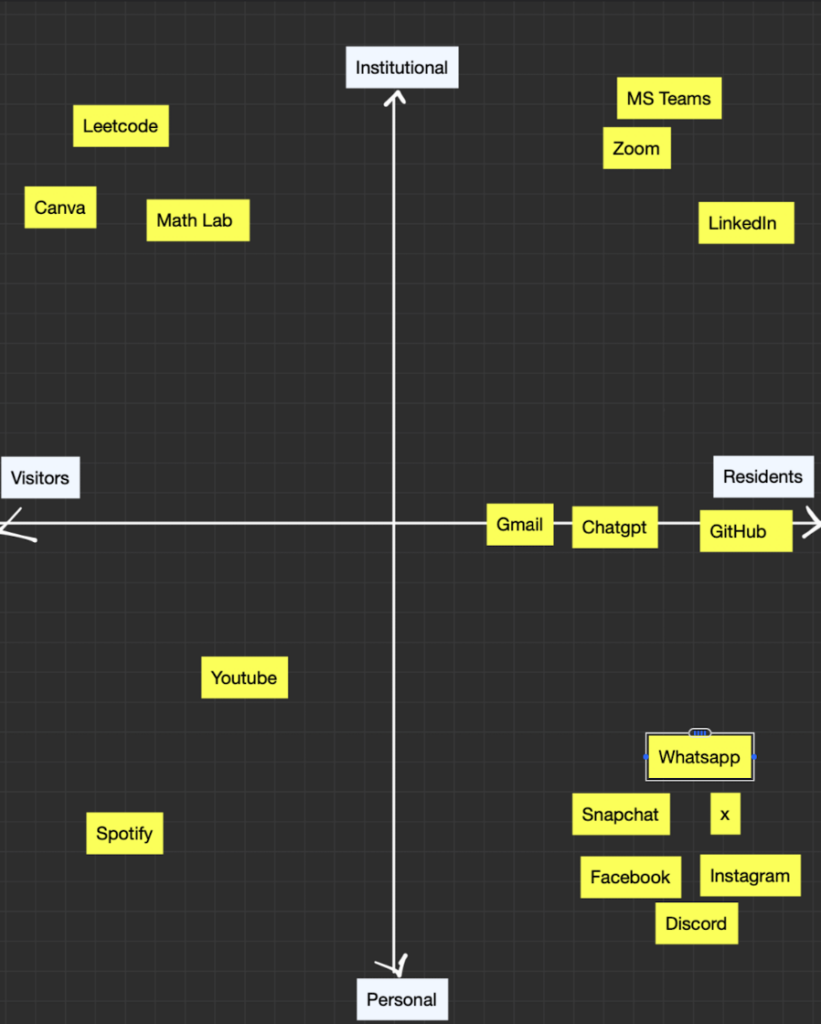
The platforms I use most to build a professional network are LinkedIn, Github, Discord, Teams and Zoom. LinkedIn Helps me connect with people, find recruiters, see hackathons, and build a professional profile for myself. I use Github usually to show real work. It helps me contribute to open source projects, and gives other people a way to look at my actual technical skills. Discord is big part of my collaboration stack, because that is where teammates ask quick questions, share files, and hop on calls. Teams and Zoom I used more in direct office work, because that is where actual meetings, updates, and support happen. Looking at my map, the main way I could expand my PLN is not by joining random new platforms, but by being more active on LinkedIn and engaging more with people outside my immediate circle.
Digital Identity and Privacy
I think I have done a decent job of separating personal and professional spaces, and that helps because my professional platforms give employer something directly useful to gauge my hard and soft skills. They can see projects, work experience, and how I communicate. But at the same time, the Digital Tattoo reading made me think more realistically about privacy, even if I separate accounts, I still do not fully control what other people post, tag or share about me.
Privacy and security can limit PLN because they make you more cautious, but they can also strengthen it because they force you to be intentional in your interactions online. It makes you realize the real life consequences of your online presence. As a computer science student, I already think a lot about secure and non-secure systems, so I naturally take extra precautions while trying to present a genuine version of myself online.
Inclusion, Communication and Community
My PLN is fairly diverse because it comes from difference places, computer science, gaming communities, hackathons, coding competitions, work experience, and the people I have met through those spaces. I have talked to people from very different backgrounds, it stops me from thinking narrowly. But this week made me think more seriously about inclusion. Networking is a way to find opportunities and improve my own work, but also a good PLN should make space for other perspectives, The reading from One Without the Other connected with that for me because is inclusion is not just about having different people around. It is about whether their voices actually matter in the conversation.
One real learning outcome from my PLN is that better work usually comes from listening to people outside your own field. During my co-op and in technical projects, I saw that if you only think like a developer, you can build the product correctly and still build the wrong product for the people who need it.
Social media helps communication by making it easier to reach people, and build community without distance being a problem but it creates its own challenges because text removes tone, body language and context. Things get misunderstood easily online. That is why I do not think is automatically inclusive because many people can join. It becomes inclusive only when people are actually head and credited. That also means my PLN should not just promote my own work. It should amplify other voices too, especially when other people have more direct experience or a better perspective on the issue being discussed.
My thinking about PLNs has changed in a lot in these two weeks. I still see them as useful for professional growth, but now I think a strong PLN also needs privacy awareness, diversity, and accountability. The biggest benefit of a diverse and inclusive PLN is that it helps you understand people better, communicate better, and build better work experience. It makes the network actually valuable, and not just large.
Sources:
UBC Digital Tattoo: https://digitaltattoo.ubc.ca/quizzes/privacy-and-surveillance/
Visitor and Resident Maps: https://firstmonday.org/ojs/index.php/fm/article/view/7802/6515
Shelley Moore and Leyton Schnellert, One Without the Other: https://ebookcentral.proquest.com/lib/uvic/reader.action?docID=4832579&p
Recent Comments